The Art of the Evening Reset: How to Recover from a Stressful Day Before It Ruins Your Night


Transitioning from a chaotic workday to a peaceful evening doesn't happen by accident. Discover how to create a gentle, personalized decompression protocol that helps you release stress and reclaim your personal time.
We have all been there. The laptop finally snaps shut, or you finally turn the key in your front door, but the chaotic energy of the day is still buzzing right beneath your skin. Your shoulders are hovering somewhere near your ears, your mind is racing through a mental loop of unanswered emails and awkward conversations, and you feel a distinct sense of lingering exhaustion.
It is incredibly common to carry the heavy residue of a stressful workday straight into your evening. When we do this, our personal time—the precious hours meant for rest, connection, and simply being—gets swallowed up by the ghost of the workday. We might find ourselves snapping at our partners, mindlessly scrolling through our phones in a state of paralysis, or just feeling a vague, persistent sense of unease until it is time to go to bed and do it all over again.
But it doesn't have to be this way. You deserve an evening that actually belongs to you.
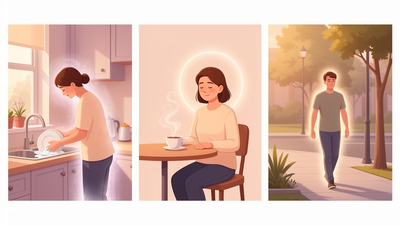
Creating a intentional transition from "work mode" to "home mode" can make a world of difference. By establishing a gentle, personalized decompression protocol, you can build a protective buffer between the demands of your day and the sanctuary of your evening.
Understanding the Lingering Stress Response
Before we dive into creating your evening reset, it is so important to offer yourself a little grace. If you find it difficult to simply "switch off" at 5:00 PM, there is absolutely nothing wrong with you. You are not failing at work-life balance; you are simply experiencing human biology.
Research suggests that our bodies do not automatically know that a stressful event is over just because we have left the office or logged out of our email. When we experience stress—whether it is a looming deadline, a difficult client, or just the overwhelming juggle of daily responsibilities—our sympathetic nervous system activates. This is our "fight or flight" state.
Even when the external stressor is removed, the internal cocktail of stress hormones like cortisol and adrenaline can continue coursing through our systems. Your body still thinks it needs to be on high alert. To transition back into a resting state (the parasympathetic nervous system, often called "rest and digest"), our bodies require active, tangible cues of safety.
Because every woman's body and life is completely different, the cues that signal safety to your nervous system might look very different from your best friend's or your sister's. The goal is not to force yourself into a rigid, one-size-fits-all evening routine, but rather to discover the gentle signals that tell your unique body: The work is done. You are safe now. You can rest.
The Doorway Ritual: Leaving Work at Work
One of the most effective ways to begin your decompression protocol is by establishing a "doorway ritual." This is a psychological and physical threshold that clearly marks the end of the workday and the beginning of your personal time.
Historically, the daily commute served this purpose. But as the lines between work and home have blurred—especially for those of us who work remotely or manage households—we often have to create these boundaries ourselves.
If You Commute
If you travel to and from a workplace, your doorway ritual can literally involve your front door. Many women find it helpful to pause for just ten seconds before turning the key or opening the car door. Take a deep breath, visualize the stress of the day gathering in your exhaled breath, and consciously leave it on the welcome mat. You might try silently saying a phrase to yourself, such as, "I am leaving my work behind me, and I am stepping into my evening."
If You Work From Home
If your office is also your living room or a spare bedroom, the doorway ritual requires a bit more intentionality. When you are finished working, do not just leave your laptop open on the coffee table. Close it. Put it in a drawer or a bag out of sight. The visual reminder of work can keep your nervous system on edge. You might try stepping outside for a five-minute walk around the block—a "fake commute"—to give your brain that crucial spatial transition before re-entering your home as your off-the-clock self.
The 10-Minute Reset: Creating Your Buffer Zone
Once you have crossed the threshold, the next step is the buffer zone. This is a 10-minute window dedicated entirely to shifting your energetic state before you dive into cooking dinner, tending to family members, or tackling household chores.
Think of this time as a decompression chamber for your nervous system. Here are a few gentle ways to spend those ten minutes.
The Sensory Shift
Our senses are powerful communicators to our nervous system. Changing your sensory inputs can rapidly signal that the environment has changed.
- Change your clothes immediately: Taking off your work clothes (even if they are just "work-from-home leggings") and putting on soft, comforting evening clothes is a profound tactile cue.
- Wash the day off: Many women find that washing their face, thoroughly washing their hands with a beautifully scented soap, or even taking a quick, warm shower helps them literally and metaphorically wash the stress of the day down the drain.
- Adjust the lighting and sound: Turn off harsh overhead lights and turn on warm lamps. Put on a specific playlist that makes you feel grounded—whether that is soft acoustic music, classical, or an upbeat pop anthem that makes you want to dance out the tension.
The Physical Release
Stress lives in the body, and sometimes we need to move it out. This isn't about "getting a workout in"—it is simply about releasing trapped energy.
- Floor time: It might sound incredibly simple, but just lying flat on your back on the floor for five minutes can be magical. The solid ground provides a deep sense of support for a tired spine and a weary nervous system. Let your limbs fall heavy and take a few deep, slow breaths.
- Gentle stretching or shaking: You might try shaking out your hands, arms, and legs. Animals naturally shake their bodies after a stressful encounter to release adrenaline. We can benefit from the exact same practice.
The Mental Unloading
If your brain is still spinning with to-do lists, trying to ignore those thoughts usually backfires.
- The brain dump: Keep a small notebook on your counter. Spend three minutes writing down every single thing you are worried about forgetting for tomorrow. Once it is on the paper, give yourself permission to stop holding it in your head.
Customizing Your Decompression Protocol
As you build your transition routine, remember to honor your current season of life and your unique personality.
If you have a bustling household with children or roommates who immediately demand your attention when you walk in, a quiet 10-minute meditation might not be realistic. Instead, your buffer might be listening to an audiobook in the driveway for five extra minutes before going inside, or asking your household for a "five-minute quiet hug time" when you walk through the door.
If you are an extrovert who finds energy in connection, your decompression protocol might involve immediately calling a friend who makes you laugh. If you are an introvert whose social battery is completely depleted by 5:00 PM, your protocol might involve absolute silence and staring out a window with a cup of herbal tea.
Tune into your own body. Does your nervous system feel like a tightly coiled spring that needs to be released through movement? Or does it feel like a drained battery that needs to be gently recharged through stillness? There is no wrong answer, and your needs might change from day to day.
Releasing the Pressure of the "Perfect" Evening
In our culture of constant self-improvement, it is easy to fall into the trap of wanting to "maximize" our evenings. We see pristine evening routines on social media and feel guilty if we aren't spending our post-work hours journaling, cooking organic meals from scratch, and engaging in perfectly curated self-care.
Please gently release this pressure. A decompression protocol is not another rigid item to add to your to-do list. It is not about forcing yourself to feel positive or productive.
Some days, despite your best efforts, the stress will linger. Some evenings, "balance" just looks like eating cereal for dinner and watching a comforting television show in your softest sweatpants. That is okay. True wellness is not about toxic positivity or pretending everything is perfect; it is about self-compassion. It is about recognizing when you are depleted and offering yourself whatever comfort is available to you in that moment.
Reclaiming Your Time
Your evening is your own. It is the space where you get to reconnect with the parts of yourself that have nothing to do with your job title, your output, or your responsibilities to the outside world.
By implementing a simple doorway ritual and a gentle 10-minute buffer, you are sending a powerful message to yourself: My peace matters. My rest is sacred. I am allowed to put the heavy things down.
Tonight, as you finish your workday, you might try choosing just one small practice from this list. Perhaps you will change your clothes the moment you log off, or maybe you will spend three minutes lying on the living room floor taking deep belly breaths. Start small, be incredibly gentle with yourself, and see how it feels to intentionally welcome yourself home.