Energy Management vs Time Management: A Gentler Approach for Women

Ditch rigid schedules and endless to-do lists. Discover how managing your energy, rather than your time, can help you honor your body's natural rhythms, reduce burnout, and create a more sustainable, joyful daily life.
Have you ever stared at a perfectly color-coded calendar, knowing exactly what you are supposed to be doing, but feeling absolutely no physical or mental capacity to actually do it?
If you are nodding your head, you are not alone. For decades, the ultimate solution to our overwhelming lives has been pitched to us as "better time management." We are handed planners, productivity apps, and time-blocking strategies, all built on a singular, flawed premise: that every hour of the day holds the exact same potential.
But as women juggling careers, caregiving, relationships, and our own well-being, we know this simply isn't true. The hour you spend sitting at your desk at 9:00 AM feels fundamentally different from the hour you spend there at 3:30 PM.
Time is finite; there will always be only 24 hours in a day. Energy, however, is dynamic. It ebbs and flows, expands and contracts. Shifting your focus from time management to energy management is a profound act of self-care. It is about working with your natural rhythms instead of constantly fighting against them.
The Time Management Trap
Traditional time management assumes we are machines. It suggests that if we just find the right system, we can optimize ourselves into peak efficiency, churning out work at a steady, uninterrupted pace.
But this industrial-era approach ignores our basic biology. It also completely overlooks the invisible, emotional, and cognitive labor that many women carry throughout the day. When we try to force ourselves into rigid time blocks, we often end up feeling like we are failing. We push through exhaustion, rely on caffeine to override our natural fatigue, and end our days feeling depleted rather than fulfilled.
We are often sold a version of productivity that borders on toxic positivity—the idea that if we just hustle harder, smile more, and wake up at 5:00 AM, we can "have it all." But research suggests that attempting to sustain high levels of output without acknowledging our physiological limits leads directly to burnout.
Energy management offers a much softer, more realistic alternative. It asks a different question: instead of asking, "How much time do I have?" we learn to ask, "What is my energy capacity right now, and how can I best use it?"
Understanding Your Natural Rhythms
To manage your energy, it helps to understand the natural rhythms that govern your body. Every woman's body and life is different, and there is no single schedule that works for everyone. However, being aware of these biological cycles can help you find what works uniquely for you.
Circadian and Ultradian Rhythms
Your circadian rhythm is your body's 24-hour internal clock, dictating your sleep-wake cycle. Some of us are naturally early birds, while others are night owls.
Within that 24-hour cycle, we also experience ultradian rhythms. Research suggests that the human brain can only focus on deep, complex work for about 90 to 120 minutes before it needs a break. After this period, you might experience a dip in energy, brain fog, or a sudden urge to scroll through your phone. This isn't a sign of laziness; it is a biological signal that your brain needs to recover.
Hormonal Fluctuations
For many women, hormonal cycles also play a significant role in energy levels. Whether you are navigating a menstrual cycle, pregnancy, postpartum recovery, perimenopause, or menopause, your hormones dictate how much energy you have on any given day or week.
During certain phases of a menstrual cycle, for instance, you might feel highly communicative and energized. During other phases, you might feel naturally drawn inward, craving rest and solitary tasks. Many women find that simply acknowledging these shifts—rather than judging themselves for not being at 100% every single day—removes a tremendous amount of guilt and frustration.
How to Practice Energy Management
Transitioning to energy management doesn't mean tossing your calendar in the trash. It simply means letting your energy, rather than the clock, dictate how you structure your days. Here are some practical ways you might try implementing this approach.
1. Audit Your Energy Patterns
The first step is to become an observer of your own life. For one week, try keeping a simple energy journal. You don't need a complicated spreadsheet—just a piece of paper or a note on your phone.
Check in with yourself three times a day (morning, afternoon, and evening) and rate your energy on a scale of 1 to 10. Notice when you feel most alert and capable of tackling difficult things. Notice when you hit a wall.
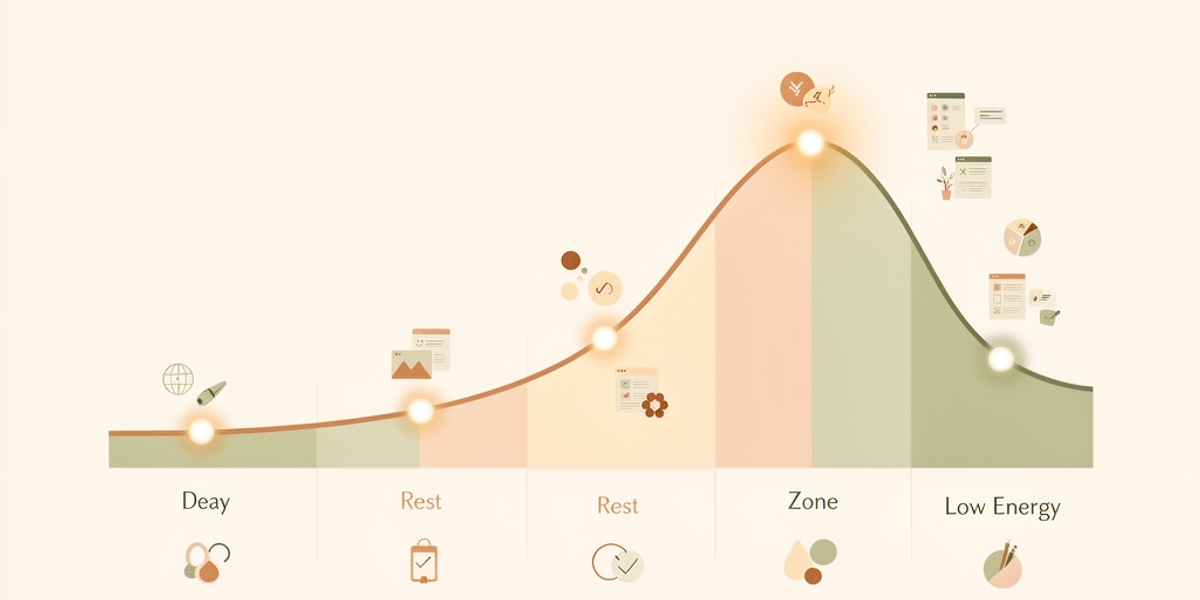
Over time, patterns will emerge. You might discover that your peak creative energy is between 9:00 AM and 11:00 AM, your energy dips significantly around 3:00 PM, and you get a small second wind around 7:00 PM.
2. Batch Tasks by Energy Level
Once you know your patterns, you can start matching your to-do list to your energy levels. Instead of organizing tasks by deadline alone, categorize them by the type of energy they require.
High-Energy Tasks: These require deep focus, creativity, emotional regulation, or strategic thinking. This might include writing a report, having a difficult conversation with a partner or colleague, making financial decisions, or engaging in a challenging workout. Guard your peak energy hours for these tasks. If your peak is in the morning, do not spend that precious time answering routine emails.
Medium-Energy Tasks: These require attention but not your absolute best cognitive resources. This could include collaborative meetings, routine problem-solving, running errands, or helping children with standard homework.
Low-Energy Tasks: These are the tasks you can do when your brain feels like mush. Administrative upkeep, organizing your inbox, folding laundry, paying bills, or meal prepping simple ingredients. Schedule these for your natural energy dips—like the dreaded mid-afternoon slump.
3. Build True Recovery Into Your Day
In a culture obsessed with doing, rest is often viewed as a weakness or a reward we have to earn. We need to unlearn this. Rest is not a reward for productivity; it is a biological requirement for it.
When we talk about recovery, we aren't just talking about sleep. Research suggests that we need various types of rest to truly recharge.
- Mental Rest: Stepping away from screens, turning off notifications, and letting your mind wander.
- Sensory Rest: Closing your eyes in a quiet, dark room for ten minutes to recover from the bright lights and loud noises of the day.
- Emotional Rest: Taking a break from caregiving or holding space for others, and doing something purely for yourself.
Instead of powering through a 90-minute work session and then immediately jumping into a stressful task, you might try building "buffer zones" into your day. Even five minutes of deep breathing or staring out a window between tasks can reset your nervous system.
Navigating Real-Life Constraints
It is important to acknowledge that not everyone has total control over their schedule. If you work a traditional 9-to-5 job with back-to-back meetings, or if you are caring for young children or aging parents, you might be thinking, "This sounds great, but I can't just take a nap at 3:00 PM because my energy is low."
That is completely valid. Energy management is not about achieving perfect control; it is about making micro-adjustments where you can.
If you can't change when you have a meeting, can you change how you show up to it? Can you take it off-camera to save sensory energy? If you are a stay-at-home parent and the afternoon slump coincides with the chaos of the post-school rush, can you prepare dinner during your high-energy morning hours instead of leaving it for the evening?
Look for the margins. Where do you have agency? Even claiming 10% more autonomy over your energy can make a massive difference in how you feel at the end of the week.
Letting Go of the Guilt
Perhaps the hardest part of shifting from time to energy management is dealing with the guilt. We have been conditioned to measure our worth by our output. When you first start honoring your need for rest, or when you leave a low-priority task undone because you simply don't have the energy for it, a voice in your head might call you lazy.
When that happens, be gentle with yourself. Acknowledge the thought, but don't let it dictate your actions. Remind yourself that you are playing a long game. Pushing through exhaustion today only borrows energy from tomorrow. By respecting your limits today, you are protecting your capacity for the future.
Your worth is not determined by how many boxes you check off a list. You do not need to earn your rest, and you do not need to apologize for honoring your body's signals.
A Gentler Way Forward
Managing your energy is a continuous practice of self-awareness and self-compassion. It requires tuning in, listening deeply, and being willing to pivot when things aren't working.
As you move through the coming days, I invite you to try a simple experiment. Before you start your next task, pause. Take a deep breath, check in with your body, and ask yourself: What is my energy telling me right now?
Whatever the answer is, try to honor it. You might just find that by slowing down and working with your natural rhythms, you actually have more to give—to your work, to your loved ones, and most importantly, to yourself.