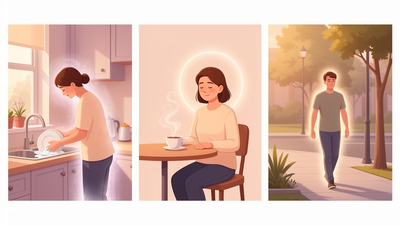
Finding Your Footing: How to Build Emotional Resilience One Small Step at a Time


True resilience isn't about ignoring pain or always being strong. It's about building your capacity to recover and adapt. Discover gentle, evidence-based ways to nurture your emotional bounce-back through self-compassion and connection.
We have all heard the familiar refrains: “What doesn't kill you makes you stronger,” or “Just power through it.” For a long time, the cultural narrative around resilience has been wrapped up in ideas of armor, toughness, and an unrelenting ability to keep pushing forward, no matter the cost. But for many of us, this definition feels not only exhausting but deeply disconnected from our lived realities.
If you have ever felt like you are failing at being “strong,” take a deep, gentle breath. You are not failing. The truth is, resilience isn't about being tough at all—it is about recovering. It is the quiet, ongoing process of building your bounce-back capacity, not by hardening your heart, but by softening into self-compassion, leaning on your community, embracing adaptability, and finding your own meaning in the messiness of life.
Every woman's body and life is different. The demands on your time, your emotional bandwidth, and your nervous system are entirely unique to you. Because of this, there is no one-size-fits-all roadmap to emotional wellbeing. However, research suggests that by taking small, intentional steps, we can all cultivate a deeper sense of emotional elasticity. Let's explore how to build that resilience together, one gentle step at a time.
The Myth of the Unbreakable Woman
For generations, women have been celebrated for their ability to carry the weight of the world. We are often praised for being the glue that holds our families, workplaces, and communities together. While there is profound beauty in our capacity to care for others, this “superwoman” ideal can quickly become a trap.
When we believe that resilience means never breaking a sweat, never crying, and never needing a break, we set ourselves up for burnout. This mindset ignores the biological and psychological realities of being human. Our nervous systems are not designed to be in a constant state of high alert or perpetual output.
Instead of viewing resilience as a shield that deflects pain, it is far more helpful to view it as a sponge. A sponge can be squeezed, twisted, and compressed under pressure, but when released, it slowly absorbs water and returns to its original shape. Resilience is that return. It is the recovery period. It is the grace you give yourself in the aftermath of a difficult moment, day, or season.
The Gentle Power of Self-Compassion
When things go wrong, the inner critic is often the first voice to speak up. “I should have known better.” “Why am I so sensitive?” “I just need to try harder.”
Many women find that they are incredibly empathetic toward their friends, yet ruthlessly critical of themselves. But research suggests that self-criticism actually undermines our ability to bounce back. It triggers our body’s threat defense system, increasing stress hormones and keeping us stuck in a cycle of anxiety and shame.
Self-compassion, on the other hand, is a powerful driver of resilience. Pioneering researchers in this field have found that treating ourselves with the same warmth, understanding, and grace that we would offer a dear friend allows our nervous system to settle. When we feel safe within ourselves, we are much better equipped to process difficult emotions and figure out our next steps.
Actionable Steps for Self-Compassion
- The "Hand on Heart" Practice: When you are feeling overwhelmed, you might try placing a hand gently over your heart or on your belly. The physical warmth and gentle pressure can signal to your nervous system that you are safe. Take three slow breaths and acknowledge your struggle: “This is a really hard moment, and it makes sense that I am feeling overwhelmed.”
- Reframing the Inner Dialogue: Notice when your inner critic takes the microphone. Gently interrupt it by asking, “Would I say this to someone I love?” If the answer is no, try to pivot the thought to something supportive. You don't need to force fake positivity; a simple “I am doing the best I can right now” is often enough.
Weaving a Web of Community and Connection
In our highly individualized society, it is easy to fall into the trap of thinking we have to heal, grow, and recover all on our own. But human beings are inherently social creatures. We are biologically wired for connection, and our nervous systems actually regulate themselves through interactions with others—a process known as co-regulation.
Resilience is rarely a solo endeavor. It is woven in the quiet moments of shared understanding: a text from a friend who checks in, a knowing glance from a coworker, or a deep conversation over a cup of tea. Building resilience means allowing yourself to be supported, which requires the vulnerability of letting others see you when you aren't perfectly put together.
Of course, building community takes time and energy, which can feel daunting when you are already running on empty. The key is to start small and prioritize safe, nourishing connections.
Actionable Steps for Building Connection
- Low-Stakes Reaching Out: You might try sending a simple message to a friend you haven't spoken to in a while. It doesn't have to be a deep dive into your struggles. A simple “Thinking of you today and sending love” can open the door to connection without draining your energy.
- Identify Your "Safe Harbor" People: Take a mental inventory of the people in your life. Who leaves you feeling energized and accepted just as you are? Who allows you to take off your mask? Focus your limited social energy on nurturing these specific relationships.
- Embrace Shared Experiences: Whether it is joining a local book club, a gentle movement class, or an online support group for women in a similar life stage, finding spaces where you share common ground can significantly reduce feelings of isolation.
Embracing Adaptability in a Changing World
If there is one constant in a woman's life, it is change. Our bodies undergo profound cyclical and seasonal shifts, our roles and responsibilities evolve, and the world around us is in a state of perpetual flux. Clinging rigidly to the way things “used to be” or the way we “should” be able to perform is a recipe for frustration.
Resilience requires adaptability—the willingness to assess your current reality and adjust your expectations accordingly. What worked for you in your twenties might not support you in your forties. The routines that fueled you before a major life transition might feel impossible now. And that is perfectly okay.
True adaptability involves listening to your body and your life with curiosity rather than judgment. It means giving yourself permission to pivot, to scale back, or to completely rewrite the rules of your day-to-day life when necessary.
Actionable Steps for Adaptability
- The Daily Check-In: Before creating your to-do list, you might try asking yourself: “What is my actual capacity today?” Some days you will have the energy to tackle a massive project; other days, taking a shower and keeping everyone fed is a monumental victory. Adjust your expectations to match your daily capacity.
- Micro-Pivots: When a plan falls apart or you hit a roadblock, practice the art of the micro-pivot. Instead of abandoning your goal entirely or forcing your way through, ask yourself, “What is the next smallest, easiest step I can take in a helpful direction?”
Making Meaning Without Toxic Positivity
When navigating hardship, you have likely encountered well-meaning advice like, “Everything happens for a reason!” or “Just look on the bright side!” This is toxic positivity. It invalidates our very real pain and demands that we slap a happy filter over our struggles.
Building emotional resilience does not mean you have to be grateful for your trauma, your stress, or your heartbreak. It does, however, involve a process called meaning-making.
Meaning-making is about finding a way to integrate difficult experiences into the broader story of your life. It is not about pretending the hard thing was actually a good thing; it is about asking, “Now that this has happened, how do I want to move forward? What have I learned about my own values, my boundaries, or my capacity to love?”
Many women find that meaning-making happens naturally over time. It might look like using a painful experience to advocate for others, or it might be as quiet as realizing that surviving a difficult season has deepened your empathy for a friend who is struggling.
Actionable Steps for Meaning-Making
- Expressive Writing: Research suggests that writing about our difficult experiences can help our brains process and organize the events, reducing emotional distress. You might try setting a timer for ten minutes and writing freely about a challenge you are facing. Don't worry about grammar or finding a silver lining—just let the words flow.
- Identify Your Core Values: Hardship often acts as a magnifying glass, showing us what truly matters. Take a moment to reflect on what values have become more important to you recently. Is it peace? Honesty? Connection? Let these values guide your next steps.
Moving Forward: Your Resilience Toolkit
Building emotional resilience is not a destination you arrive at; it is a garden you tend to over the course of your life. There will be seasons of drought where you feel fragile, and seasons of bloom where you feel vibrant and grounded. Both are natural, and both are okay.
Remember to discard the one-size-fits-all advice that tells you there is a "right" way to heal or a "perfect" routine that will shield you from stress. You are the ultimate expert on your own life. Take the tools that resonate with you—whether that is a self-compassion practice, a deepened connection with a friend, or a new commitment to adapting your expectations—and leave the rest behind.
As you navigate the beautiful, complex reality of your days, I encourage you to be incredibly gentle with yourself. Celebrate your recoveries, no matter how small they seem. If you are breathing, if you are trying, if you are simply existing through a hard moment, you are already practicing resilience. Keep taking those small steps, honor the unique rhythm of your own life, and trust that your capacity to bounce back is growing stronger with every beat of your heart.