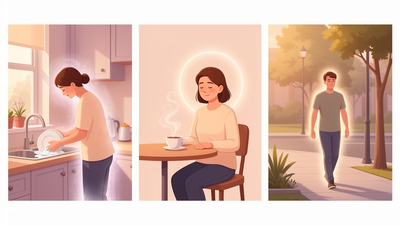
The 5-Minute Stress Reset You Can Do Anywhere: A Gentle Guide to Finding Calm


Feeling overwhelmed? Discover a gentle, portable 5-minute stress reset using breathwork, muscle release, and sensory grounding. This simple sequence can help bring your nervous system back to baseline, wherever you are.
The Weight We Carry
We live in a world that often demands us to be "on" all the time. Between managing careers, nurturing families, maintaining relationships, and carrying the invisible mental load that so often falls on our shoulders, it is entirely natural to feel overwhelmed. If you frequently find yourself operating in survival mode, with your shoulders creeping up toward your ears and your mind racing through endless to-do lists, please know that you are not alone, and you are certainly not failing.
Many women find that their days are a marathon of putting out fires, leaving little room to simply breathe. We are often told to "just relax" or "find balance," but these platitudes can feel frustratingly out of reach when you are in the middle of a chaotic Tuesday. Toxic positivity tells us to simply smile through the stress, but true wellness requires acknowledging our reality: life is intensely demanding, and it is okay to feel the weight of it.
While we cannot always change the external stressors in our lives—we cannot magically eliminate deadlines, caregiving responsibilities, or the complexities of modern womanhood—we can build a toolkit to help our internal landscape weather the storm.
Understanding Your Nervous System
Before diving into the reset, it helps to understand what is happening inside your body when overwhelm strikes. Research suggests that chronic stress keeps our nervous system locked in a sympathetic "fight or flight" state. This isn't a character flaw; it is a brilliant biological mechanism designed to keep you safe from danger. Your heart rate increases, your breathing becomes shallow, and your muscles tense up, ready for action.
However, our bodies cannot easily distinguish between a physical threat and the stress of an overflowing inbox, a toddler's meltdown, or a difficult conversation with a partner. When we stay in this heightened state for too long, it takes a toll on our physical and emotional well-being.
The goal of this 5-minute reset is not to achieve a state of permanent zen—that is an unrealistic expectation. Instead, the goal is to send a clear, biological signal of safety to your brain, gently inviting your nervous system to shift back into its parasympathetic "rest and digest" baseline.
The Portable Calm-Down Sequence
This 5-minute stress reset is entirely portable. You require no special equipment, no quiet meditation room, and no change of clothes. You can do this in your parked car before walking into work, locked in the bathroom for a moment of peace, sitting at your desk, or during a chaotic school pickup line.
Because every woman's body and life is different, please view these steps as invitations rather than strict rules. If a particular step doesn't feel right for you today, simply skip it or modify it.
Minute 1: Grounding Through the Senses
When we are stressed, our minds are usually time-traveling—worrying about the future or ruminating on the past. Sensory grounding acts as an anchor, pulling your brain back into the present moment.
For the first minute of your reset, you might try a modified version of the 3-2-1 grounding technique. Keep your eyes open and gently scan your environment.
- Acknowledge 3 things you can see: Look for details you might normally miss. Notice the exact shade of green on a houseplant, the way the light reflects off your coffee mug, or the texture of the fabric on your sleeve. Name them silently to yourself.
- Acknowledge 2 things you can feel: Bring your attention to your physical boundaries. Feel the solid weight of your feet pressing into the floor, or the texture of your clothing against your skin. If you are sitting, notice the support of the chair beneath you.
- Acknowledge 1 thing you can hear: Listen closely. You might hear the hum of a refrigerator, distant traffic, or the sound of your own breath.
Research suggests that intentionally shifting your focus to external sensory details interrupts the brain's internal stress loop, bringing a rapid sense of presence and safety.
Minutes 2 and 3: Box Breathing (Four-Square Breathing)
Now that you are anchored in the present, we move to the breath. Your breath is the remote control for your nervous system. By consciously altering your breathing pattern, you can directly lower your heart rate and signal safety to your brain.
Box breathing is a gentle rhythmic technique used by everyone from athletes to healthcare workers to manage acute stress.
Here is how to do it:
- Exhale: Gently blow all the air out of your lungs through your mouth.
- Inhale: Close your lips and inhale smoothly through your nose for a slow count of four. (1... 2... 3... 4...)
- Hold: Hold the air in your lungs for a count of four. Try not to clamp your throat shut; just let the air rest there.
- Exhale: Slowly release the breath through your mouth for a count of four.
- Hold: Hold your lungs empty for a count of four.
Repeat this cycle for about two minutes.
A gentle note on breathwork: Many women find focusing on their breath deeply relaxing, but for others, it can actually induce anxiety. If holding your breath feels uncomfortable or triggers panic, please drop the holds. You might try simply extending your exhales instead. Inhaling for a count of four and exhaling for a count of six is a wonderful, research-backed alternative that is incredibly effective at stimulating the vagus nerve and calming the body.
Minutes 4 and 5: Progressive Muscle Release
As women, we often carry an immense amount of physical tension without even realizing it. We clench our jaws, hike our shoulders up to our ears, and unknowingly tighten our pelvic floors while answering emails or driving.
Progressive Muscle Release (PMR) involves intentionally tensing and then deeply relaxing specific muscle groups. This contrast helps your brain recognize what true relaxation feels like in the body.
For the final two minutes of your reset, focus on the areas where you typically hold stress:
- The Face and Jaw: Squeeze your eyes shut tightly, scrunch your nose, and clench your jaw (gently, to protect your teeth). Hold this tension for three seconds. Now, release. Let your jaw drop open slightly. Feel the space between your eyebrows soften. Imagine the tension melting off your cheekbones.
- The Shoulders and Neck: Pull your shoulders up toward your ears as tightly as you can. Hold for three seconds. Then, let them drop completely. Imagine heavy weights pulling your shoulders down and away from your neck. Roll your neck gently from side to side.
- The Hands and Arms: Clench your hands into tight fists. Squeeze the muscles in your arms. Hold for three seconds. Release, letting your fingers naturally curl and your arms hang heavy and loose by your sides.
- The Pelvic Floor and Core: Take a deep breath in and gently squeeze your abdominal muscles and pelvic floor. Hold for three seconds. As you exhale, release entirely. Allow your belly to be soft and round. (We spend so much time holding our stomachs in; give yourself permission to take up space and let your belly completely relax).
Making the Practice Your Own
Every woman's body and life is different, which means your stress reset should be customized to fit your unique needs. There is no one-size-fits-all approach to wellness.
If you only have two minutes instead of five, just pick one element. Perhaps you only do the grounding exercise while waiting in line at the grocery store. Perhaps you practice box breathing while the shower water warms up in the morning.
If you find that stillness makes you more anxious, you might try a "moving reset." You can practice sensory grounding while taking a brisk walk around the block, or coordinate your box breathing with your footsteps. The goal is to find what feels supportive and nourishing for your specific nervous system.
Troubleshooting and Self-Compassion
It is important to remember that this 5-minute reset is a tool, not a magic wand. There will be days when you complete this sequence and still feel a lingering sense of stress. That does not mean you did it wrong, and it does not mean the practice is broken.
Some days, the overwhelm is simply heavier than others. On those days, the kindest thing you can do is to offer yourself grace. Acknowledge that you are carrying a lot, and validate your own experience.
Avoid the trap of feeling guilty for being stressed. Wellness culture often inadvertently shames women for not being perfectly balanced, but balance is a fluid, ever-changing state, not a permanent destination. Doing this sequence is an act of self-care, regardless of whether it cures your stress entirely or just takes the edge off.
Moving Forward with Gentleness
The most powerful aspect of this 5-minute reset is that it puts the power of self-regulation back into your hands. You don't need a spa weekend or a costly retreat to offer your nervous system a moment of peace. You carry the tools for calm within you at all times—in your senses, in your breath, and in your body.
As you navigate the beautiful, messy, demanding reality of your daily life, I invite you to keep this sequence in your back pocket. The next time you feel the familiar wave of overwhelm rising, you might try stepping away, even just mentally, for five brief minutes.
Pause. Ground yourself. Breathe. Release.
You do so much for everyone else around you. You deserve to carve out five minutes of profound gentleness just for yourself.