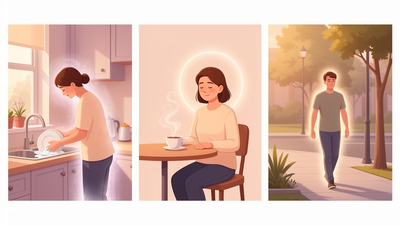
The Art of Doing Nothing: Why Rest Isn't Laziness


In our productivity-obsessed world, doing nothing often feels like a flaw. But research suggests unstructured time is essential for your brain. Discover how to reclaim rest, ditch the guilt, and give yourself permission to just be.
Have you ever found yourself with a rare, unexpected free hour, only to immediately start organizing a junk drawer, scrolling through work emails, or feeling a creeping sense of anxiety because you aren't "getting things done"?
If you are nodding your head, please know you are not alone. We live in a culture that often treats exhaustion as a status symbol and equates our fundamental human worth with our daily output. From the moment we wake up, we are bombarded with messages telling us to optimize our routines, maximize our efficiency, and hustle harder. In this environment, choosing to literally do nothing feels countercultural. It can feel uncomfortable. It can even feel like laziness.
But here is the gentle truth: you are a human being, not a machine. Your worth is not determined by how many items you cross off a to-do list. Reclaiming rest is not a sign of weakness or a lack of ambition; it is a profound act of self-care and a biological necessity.
The Productivity Trap and the Mental Load
For many women, the pressure to be constantly productive is compounded by the invisible mental load we often carry. Whether you are managing a household, navigating a demanding career, caring for aging parents, raising children, or simply trying to keep your own life organized, the baseline hum of responsibility rarely quiets down.
Society subtly (and sometimes not so subtly) implies that a woman's time should always be in service of something or someone else. If we aren't working, we should be self-improving. If we aren't caring for others, we should be organizing our homes. This constant state of hyper-vigilance leaves our nervous systems frayed and our spirits depleted. We learn to view rest as something we must "earn" after all the chores are done—but the chores are never truly done.
It is important to acknowledge that every woman's body and life is different. What feels deeply restful to one person might feel anxiety-inducing to another. Furthermore, the privilege of having time to rest varies wildly depending on your life circumstances, socioeconomic status, and caregiving responsibilities. A single mother working two jobs faces entirely different barriers to rest than an empty-nester. There is no one-size-fits-all approach to finding balance, and recognizing your unique season of life is the first step in granting yourself grace.
The Neuroscience of Doing Nothing
When we talk about doing nothing, we aren't just talking about sleeping. We are talking about unstructured, demand-free time. Time spent staring out a window, sitting on the porch with a cup of tea, or lying on the floor watching the ceiling fan spin.
To our productivity-obsessed minds, this looks like wasted time. But research suggests something entirely different. When you stop focusing on a specific task, your brain does not power down. Instead, it activates a web of interconnected brain regions known as the Default Mode Network (DMN).
Research suggests that the DMN is highly active when we are daydreaming, letting our minds wander, or simply "being." This network is responsible for a tremendous amount of vital cognitive and emotional work. When the DMN is engaged, your brain is busy connecting disparate ideas, consolidating memories, processing complex emotions, and fostering creativity.
Have you ever struggled with a problem for days, only to have the perfect solution pop into your head while you were gazing out the window during a bus ride or standing in the shower? That is your Default Mode Network in action. Your brain needs unstructured time—often perceived as boredom—to weave together the threads of your experiences. Depriving your brain of this downtime is like asking a sponge to keep soaking up water without ever wringing it out.
Unlearning the Guilt of Rest
Understanding the neuroscience of rest is one thing; actually allowing yourself to rest without guilt is another journey entirely.
Many women find that when they finally sit down to do nothing, a loud inner critic chimes in. You should be folding that laundry. You should be returning that text message. You are wasting the day.
This internalized voice is the echo of a society that values us for what we produce rather than who we are. It is not an objective truth. When that guilt arises, try to meet it with self-compassion rather than judgment. You might gently remind yourself, "My body and mind require stillness to function. I am allowed to just exist."
It is also vital to separate rest from the concept of "earning it." You do not have to exhaust yourself to deserve a break. You do not have to push your body to its absolute limits to justify sitting on the couch. Rest is a fundamental human need, much like drinking water or breathing air. You deserve rest simply because you are alive.
Redefining What "Nothing" Looks Like
Doing nothing doesn't have to mean sitting cross-legged in a perfectly quiet room meditating. In fact, placing strict rules around how you rest can ironically turn rest into just another item on your to-do list.
Doing nothing is about removing cognitive demands and external inputs. It means untethering yourself from the constant stream of information, entertainment, and obligation. Scrolling through social media, while physically passive, is highly stimulating for your brain. Listening to an educational podcast, while enjoyable, still requires cognitive processing.
True unstructured time is about letting your mind wander without a leash. It is about sensory boundaries. It is about giving yourself permission to be beautifully, wonderfully unproductive.
Gentle Ways to Reclaim Unstructured Time
If the idea of doing nothing feels foreign or overwhelming, that is completely okay. You don't have to suddenly carve out hours of empty time. Like any new skill, the art of doing nothing takes practice. Here are a few gentle ways to begin incorporating unstructured time into your daily rhythm.
1. Embrace Micro-Doses of Nothing
Many women find it helpful to start incredibly small. You might try finding just three to five minutes a day to simply exist. When you finish a task, instead of immediately jumping to the next one, pause. Sit in your chair, look at the wall, and take a few deep breaths. When you park your car in the driveway, sit in the driver's seat for two extra minutes before rushing inside. These micro-doses of nothing help signal to your nervous system that it is safe to pause.
2. Create "Input-Free" Windows
We are constantly consuming information. To give your Default Mode Network a chance to activate, try creating small windows of time where you consume absolutely no inputs. You might try drinking your morning coffee without looking at your phone, or folding a basket of laundry in silence instead of having the television on in the background. Notice where your mind goes when it isn't being directed by a screen or a speaker.
3. Schedule "Buffer Time"
If your day is tightly packed, try scheduling five to ten minutes of buffer time between appointments or tasks. Do not fill this time with emails or quick chores. Let this be transitional time where you do absolutely nothing but transition from one state of being to another.
4. Practice "Cozy Boredom"
Boredom has gotten a bad reputation, but it is actually the birthplace of creativity. You might try creating an environment that makes boredom feel luxurious rather than punishing. Wrap yourself in a soft blanket, light a candle, and just sit. Let yourself feel bored. Notice the urge to pick up your phone, acknowledge it without judgment, and let the urge pass.
5. Talk Back to the Guilt
When the guilt inevitably creeps in, have a gentle phrase ready to soothe your inner critic. You might try saying to yourself, "I am nourishing my nervous system," or "Rest is productive for my well-being," or simply, "I am allowed to rest." Over time, these gentle reminders can help rewire the way you view your unstructured time.
A Gentle Call to Action
Reclaiming the art of doing nothing is a deeply personal and ongoing practice. It requires pushing back against a culture that demands constant motion, and bravely choosing to honor your own humanity.
Today, I invite you to find just five minutes to do absolutely nothing. Put your phone in another room. Leave the dishes in the sink. Sit by a window, look out at the sky, and simply breathe. Notice how it feels to let go of the "doing" and embrace the "being." You don't have to fix anything, solve anything, or produce anything. For these five minutes, just being you is entirely enough.