Your Anxiety Management Toolkit: 10 Strategies That Actually Help

Anxiety isn't a one-size-fits-all experience, and your coping strategies shouldn't be either. Discover a supportive toolkit of 10 practical strategies, from breathwork to connection, designed to help you navigate different types of worry.
We all know that familiar flutter in the chest, the racing thoughts at 2 AM, or the sudden, unexplained tightness in our shoulders. Anxiety is a deeply human experience, but for many of us juggling the complex, beautiful, and often overwhelming demands of modern womanhood, it can sometimes feel like an unwelcome roommate who refuses to pack up and move out.
From managing the invisible mental load of household logistics to navigating careers, relationships, and caregiving, the modern woman's nervous system is frequently asked to process an immense amount of data. If you have ever tried to just "deep breathe" your way out of a spiraling thought pattern and felt incredibly frustrated when it didn't work, please know that you are not alone.
Anxiety isn't a monolith. Sometimes it arrives as a sharp, acute panic that steals your breath; other times, it is a low-level hum of persistent worry, or a heavy, aching physical tension in your jaw and hips. Because anxiety shows up in so many different ways, a one-size-fits-all approach simply doesn't work. Every woman's body and life is different. What soothes your nervous system on a quiet Tuesday morning might not be what you need in the middle of a chaotic Friday night.
That is exactly why building an "anxiety toolkit" is so empowering. Just as you wouldn't use a hammer to tighten a delicate screw, you need different tools for different moments of anxiety.
Here are 10 practical, evidence-aware strategies to add to your personal toolkit, categorized by how your anxiety might be showing up in the moment. Take what resonates, leave what doesn't, and remember to be incredibly gentle with yourself along the way.
Tools for Acute Anxiety (When the panic is happening right now)
When anxiety spikes suddenly, your nervous system is thrown into a primal fight-or-flight mode. The logical, rational part of your brain essentially goes offline, which is why trying to "think positive" in these moments rarely works. Instead of forcing a mindset shift, you might try tools that communicate safety directly to your biology.
1. The Physiological Sigh
When you are in the middle of an anxiety spike, research suggests that the physiological sigh is one of the absolute fastest ways to lower autonomic arousal. It is a specific breathing pattern naturally built into our nervous system—think of the double-inhale a child does when they are calming down after crying.
How to use it: Take a deep breath in through your nose. Once your lungs feel full, take a second, shorter sip of air to expand the tiny air sacs (alveoli) in your lungs completely. Then, exhale slowly and fully through your mouth with a soft, relaxing sigh. Repeat this two or three times. Many women find that this simple, accessible reset helps lower their heart rate almost immediately.
2. Temperature Shifts
If you feel entirely overwhelmed or on the verge of a panic attack, changing your body temperature can act as a gentle reset button for your vagus nerve, the superhighway of your parasympathetic (rest and digest) nervous system.
How to use it: Splash cold water on your face, hold an ice cube in the palm of your hand, or place a cool, damp washcloth on the back of your neck. The sudden, safe change in physical temperature interrupts the panic cycle and brings your brain's focus rapidly back to your immediate physical reality.
3. The 5-4-3-2-1 Sensory Grounding Method
When your mind is racing terrifyingly fast into the future, your physical senses can act as heavy anchors to hold you in the present moment.
How to use it: Look around your environment and name out loud: Five things you can see, four things you can physically feel (like the softness of your sweater or the chair beneath you), three things you can hear, two things you can smell, and one thing you can taste. Naming these things aloud gives your brain a highly concrete task, pulling it away from the exhausting spiral of "what ifs."
Tools for Physical Tension (When anxiety lives in your body)
Sometimes anxiety doesn't look like racing thoughts at all; it looks like a clenched jaw, tight hips, a knot in your stomach, or a rigid pelvic floor. When your body is holding onto chronic stress, moving that energy through you can be profoundly healing.
4. Somatic Shaking
Animals naturally shake their bodies after a stressful event to release adrenaline and complete the stress cycle. As humans—and particularly as women, who are often conditioned by society to be still, quiet, and contained—we frequently suppress this natural instinct.
How to use it: Stand up in a safe, private space and start shaking your hands. Let the shake travel up your arms, into your shoulders, and down through your torso, hips, and legs. Put on a song you love and just let your body jiggle, bounce, and shake for two to three minutes. Please note: this is absolutely not about burning calories, "earning" your food, or punishing your body. It is simply about letting your beautiful, capable nervous system discharge pent-up survival energy.
5. Progressive Muscle Relaxation (PMR)
If shaking feels like too much, or if you are in a setting where it isn't practical, you might try a more structured, quiet approach to releasing physical tension.
How to use it: Lie down comfortably. Starting with your toes, tense the muscles as tightly as you can for five seconds, then completely release them, noticing the profound contrast between tension and relaxation. Slowly work your way up your body—your calves, your thighs, your abdomen, your hands, your shoulders, and finally, your face and jaw. Many women find this especially helpful when trying to wind down for sleep after a highly stimulating day.
Tools for Persistent Worry (When your mind won't turn off)
For the slow-burning, persistent worries that loop endlessly in your mind, physical tools might only provide temporary relief. This is where cognitive tools—strategies that help you organize, validate, and process your thoughts—truly shine.
6. "Brain Dump" Journaling
When your thoughts are swirling, keeping them trapped in your head only magnifies their power. Getting them onto paper externalizes the worry, making it feel much more manageable and less consuming.
How to use it: Grab a notebook and write down everything that is bothering you, no matter how big or small. Don't worry about grammar, spelling, or making sense. Just let the mental load flow out of you. Once it is on paper, you can look at it objectively. You might even physically shut the journal and put it in a drawer, symbolizing that you are putting those heavy thoughts away for the time being.
7. Scheduled Worry Time
It sounds entirely counterintuitive, but research suggests that scheduling a specific, contained time to worry can actually reduce your overall anxiety throughout the day.
How to use it: Set aside 15 minutes in your afternoon (try to avoid doing this right before bed) as your designated "worry time." If an anxious thought pops up at 10 AM, gently tell yourself, "I see that worry, and it is valid, but I am going to save it for 4 PM." When 4 PM arrives, allow yourself to worry freely and write it all down. Often, by the time the appointment rolls around, the worry has lost its sharpest edge and urgency.
Tools for Spiraling and Disconnection (When you feel alone in it)
Anxiety thrives in isolation and secrecy. When you are stuck in an anxious spiral, the world can feel very small, very dark, and very lonely. Reconnecting with others—and with yourself—is a vital, life-affirming tool.
8. Co-Regulation Through Connection
As human beings, our nervous systems are deeply social. We are biologically designed to regulate and calm down in the presence of other safe, grounded nervous systems. This beautiful phenomenon is called co-regulation.
How to use it: Reach out to a trusted friend, partner, or family member. You don't even have to talk about your anxiety if you don't want to. Sometimes just hearing a loved one talk about their mundane day, or asking for a long, firm hug, is enough to signal to your body that you are deeply safe. If human connection feels too complicated or vulnerable in the moment, petting a dog or cat offers incredibly similar, powerful co-regulating benefits.
9. Setting Gentle Input Boundaries
We live in an era where we are constantly bombarded with breaking news, push notifications, and the curated highlight reels of other people's lives. For many of us, this unrelenting stream of digital input is a massive, exhausting trigger for anxiety.
How to use it: Notice how your body feels after scrolling through social media or reading the news. If it leaves your chest feeling tight or your mind on edge, you might try setting some gentle, loving boundaries. This could look like turning off non-essential push notifications, instituting a "no screens in the bedroom" rule, or simply taking a restorative 24-hour digital detox on the weekend.
Tools for Daily Nourishment (Building baseline resilience)
Managing anxiety isn't just about what you do when you feel terrible; it is also about how you proactively nurture and care for yourself when you feel okay. Building a gentle baseline of resilience helps soften the blow when the waves of anxiety inevitably do strike.
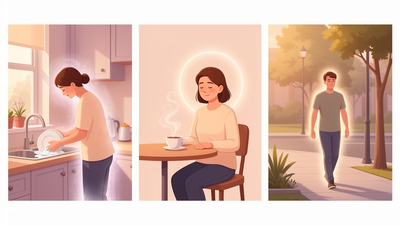
10. Cultivating Glimmers
You have probably heard of "triggers," but have you ever heard of "glimmers"? Coined by clinical social worker Deb Dana, glimmers are micro-moments that gently cue our nervous system to feel safe, connected, and at peace.
Please note: looking for glimmers is not about toxic positivity. It is never about forcing yourself to "just smile" or "look on the bright side" when you are genuinely struggling or grieving. Instead, it is about gently noticing the small, neutral-to-good things that already exist alongside the hard things in your day.
How to use it: Keep a soft eye out for tiny moments of peace. It might be the grounding warmth of your coffee mug in your hands, the smell of rain on the pavement, a stranger holding the door for you, or the way the morning sunlight hits your living room wall. Many women find that simply acknowledging these glimmers—perhaps by pausing for ten seconds to breathe and soak them in—slowly helps rewire their brain to look for safety rather than constantly scanning for danger.
Finding Your Unique Balance
Building an anxiety toolkit is a deeply personal, ongoing journey. What works beautifully for your sister or your best friend might do absolutely nothing for you, and that is perfectly okay. Every woman's body and life is different, and your needs will naturally ebb and flow with the changing seasons of your life.
The goal of this toolkit isn't to completely eradicate anxiety forever—that is an impossible, perfectionistic standard that only creates more stress. The true goal is to build a trusting relationship with your anxiety, where you feel equipped, supported, and wonderfully capable of riding the waves when they come.
Please remember that while these tools can be incredibly supportive for daily balance, they are not a substitute for professional medical or psychological care. If anxiety is heavily impacting your ability to sleep, eat, or enjoy your beautiful life, reaching out to a therapist, counselor, or doctor is a profound act of self-love and courage.
As you move through your week, you might try experimenting with just one or two of these tools. There is no rush, and there is no "right" way to heal. Be incredibly patient with yourself, celebrate your small victories, and remember: you already have so much resilience and wisdom within you. Take a deep breath. You've got this.