The 20-Minute Home Workout That Fits Into Your Actual Life (No Equipment Needed)

Discover a gentle yet effective 20-minute full-body circuit you can do in your living room. No equipment needed—just supportive, flexible movements designed to fit into your busy life and honor your unique body.
Finding Joy in Movement, Right Where You Are
Life is a beautiful, complex, and often overwhelming juggling act. Between work, family, household tasks, and trying to carve out a tiny sliver of time for yourself, the idea of packing a gym bag, commuting, and spending an hour on a treadmill can feel less like self-care and more like just another chore on an endless to-do list.
If you have ever felt guilty for skipping a workout because you simply didn't have the time or the energy, please take a deep breath and let that guilt go. Every woman's body and life is different, and the way we move our bodies should adapt to our lives, not the other way around.
Movement is meant to be a tool that supports your life, helping you feel more capable, energized, and grounded. It doesn't have to be punishing to be effective. In fact, many women find that releasing the pressure of a "perfect" 60-minute gym session opens the door to so much more joy and consistency in their movement routines.
Enter the 20-minute, no-equipment home workout.
The Science of Short, Supportive Workouts
You might be wondering if 20 minutes is really "enough." Diet culture and traditional fitness marketing have long pushed the narrative that if you aren't exhausted and dripping in sweat for an hour, you aren't doing it right. But research suggests something entirely different.
Studies consistently show that "exercise snacks" or shorter bursts of movement throughout the week offer immense benefits for our cardiovascular health, metabolic function, and mental well-being. A focused 20-minute session can help regulate your nervous system, clear brain fog, and build functional strength that makes everyday tasks feel easier. It is entirely possible to support your heart, muscles, and mind in the time it takes to watch half an episode of your favorite sitcom.
The goal here isn't to shrink or exhaust yourself. The goal is vitality. It is about taking a brief pause in your day to reconnect with your physical self, honoring what your body can do right here, right now, in the middle of your living room.
Preparing Your Space (and Your Mind)
One of the most beautiful aspects of a bodyweight circuit is the low barrier to entry. You don't need resistance bands, dumbbells, or a fancy yoga mat—though if you have a mat and it makes you more comfortable, absolutely use it.
All you need is enough floor space to step back and lie down.
Before you begin, you might try taking just one minute to transition from the chaos of your day into your body. Stand with your feet hip-width apart, roll your shoulders back, and take three deep breaths. Remind yourself that this time is a gift you are giving to yourself. If your mind wanders to your grocery list or your inbox, gently guide it back to the sensation of your feet on the floor.
The Full-Body Living Room Circuit
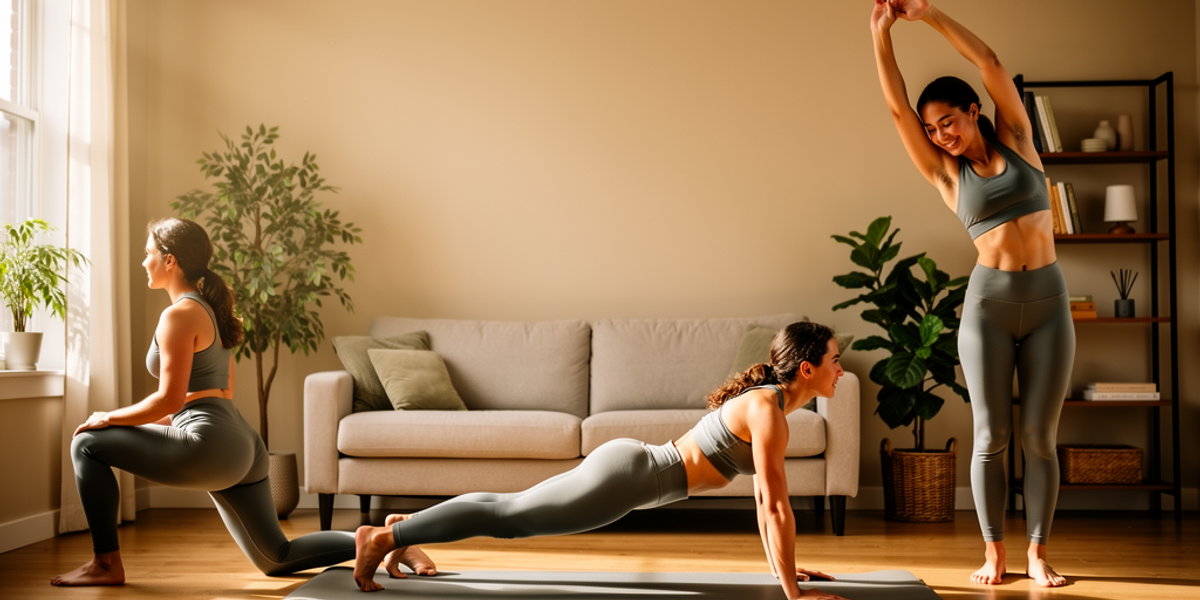
This circuit consists of five foundational movements: squats, push-ups, lunges, planks, and mountain climbers. These are functional exercises, meaning they mimic the ways we move in our daily lives—picking up a toddler, pushing a heavy door, or balancing on uneven ground.
1. Squats: Grounding and Powerful
Squats are a wonderful way to build strength in your lower body, supporting your knees, hips, and lower back.
How to do it: Stand with your feet about shoulder-width apart. As you lower down, imagine you are sitting back into a chair. Keep your chest lifted and your heels firmly planted on the floor. Go only as low as feels comfortable for your joints, then press through your feet to stand back up.
Make it yours: If you experience knee sensitivity, you might try placing a sturdy dining chair behind you and simply practicing sitting down and standing back up. This provides security and helps build the exact same functional strength.
2. Push-Ups: Upper Body Empowerment
Push-ups are incredible for building strength in your chest, shoulders, and core. However, they are also an exercise that many of us have complicated relationships with due to old physical education class standards.
How to do it: Start in a plank position with your hands slightly wider than your shoulders. Lower your body by bending your elbows, keeping your core engaged, and then press back up.
Make it yours: There is absolutely no moral superiority to doing a push-up on your toes. Many women find that doing push-ups elevated against a wall, a kitchen counter, or the back of a sturdy sofa allows them to focus on excellent form and engage their muscles without straining their lower back or shoulders. You can also drop to your knees. Choose the variation that makes you feel strong, not defeated.
3. Lunges: Balance and Stability
Lunges challenge our balance and build unilateral (one-sided) strength, which is vital for correcting natural imbalances in our bodies.
How to do it: Step one foot forward and lower your hips until both knees are bent at approximately a 90-degree angle. Keep your front heel on the ground and your chest upright. Push off your front foot to return to the starting position, then switch legs.
Make it yours: Forward lunges can sometimes feel abrupt on the knees. Research suggests—and many physical therapists agree—that reverse lunges (stepping backward instead of forward) are often much gentler on the knee joint while offering the same muscle-strengthening benefits. If balance is tricky today, gently hold onto a wall or a chair as you move.
4. Planks: Core Connection
Rather than doing hundreds of crunches, planks work your entire core as a stabilizing unit, which helps protect your spine during everyday activities.
How to do it: Place your hands or forearms on the floor, step your feet back, and hold your body in a straight line from your head to your heels. Draw your belly button gently toward your spine and remember to breathe.
Make it yours: If holding a full plank causes dipping in your lower back, gently lower your knees to the floor. You are still working your core! Alternatively, you can do a standing plank by placing your forearms on a wall and stepping your feet back.
5. Mountain Climbers: A Gentle Heart Rate Lift
This final move adds a cardiovascular element to the circuit, helping to invigorate your system and get your blood flowing.
How to do it: Start in a high plank position. Bring one knee toward your chest, then quickly switch, bringing the other knee in. It mimics a running motion in a plank position.
Make it yours: You do not have to move fast. Slow, deliberate mountain climbers (often called "plank step-ins") are highly effective and keep the heart rate elevated without feeling frantic. You can also do these elevated, placing your hands on a chair or counter.
Structuring Your 20 Minutes
How you put these moves together is entirely up to you. Here is a gentle, time-based structure that removes the pressure of counting repetitions:
The Warm-Up (3 Minutes): Spend a few minutes gently rolling your shoulders, twisting your torso, and doing some light marching in place. Let your body know it's time to move.
The Circuit (14 Minutes): Perform each of the five exercises for 40 seconds, followed by 20 seconds of rest.
- Squats (40 seconds)
- Rest (20 seconds)
- Push-ups (40 seconds)
- Rest (20 seconds)
- Lunges (40 seconds)
- Rest (20 seconds)
- Planks (40 seconds)
- Rest (20 seconds)
- Mountain Climbers (40 seconds)
- Rest (20 seconds)
This sequence takes 5 minutes. Repeat it for a total of 3 rounds (which will take 15 minutes, or slightly less if you trim the rest on the final round).
The Cool Down (3 Minutes): Finish by lying on your back, hugging your knees to your chest, or stretching your arms overhead. Breathe deeply and thank your body for its effort.
Honoring Your Ebb and Flow
It is incredibly important to remember that your energy levels will naturally fluctuate. Some days, you will feel vibrant and capable of moving quickly through this circuit. Other days, you might feel fatigued, perhaps due to poor sleep, stress, or where you are in your menstrual cycle.
On those lower-energy days, you might try turning this circuit into a slow-motion stretching and mobility session. Do a few gentle squats, hold a wall plank for a few breaths, and simply stretch. Consistency is about showing up for yourself, but how you show up can and should change. There is no one-size-fits-all approach to wellness, and forcing your body through an intense workout when it desperately needs rest is counterproductive.
Practical, Actionable Takeaways
To help seamlessly integrate this 20-minute movement practice into your life, consider these gentle strategies:
- Habit Stacking: You might try attaching this workout to an existing daily habit. For example, do your circuit right after you start the dishwasher in the evening, or immediately after brushing your teeth in the morning.
- Dress for Comfort, Not Performance: You don't need matching, high-compression workout gear to move in your living room. Pajamas, loose sweatpants, or an old t-shirt are perfectly fine. Remove the friction of "getting ready" to work out.
- Curate Your Vibe: Put on a playlist that makes you feel good. Whether that is upbeat 90s pop, relaxing acoustic guitar, or a fascinating podcast, let auditory joy carry you through the 20 minutes.
- Embrace the "Something is Better Than Nothing" Mindset: If you get through one round (5 minutes) and your baby wakes up, or you realize you are simply too exhausted to continue, stop. Five minutes of movement is wonderful. Celebrate it.
A Gentle Invitation
Reclaiming your relationship with exercise starts with small, compassionate steps. You don't need to transform your life overnight, and you certainly don't need to buy expensive equipment to prove your dedication to your health.
Next time you find yourself with a small pocket of time and a desire to clear your head, I invite you to try this living room circuit. Roll out a mat or just stand barefoot on your rug. Listen to your body, take the modifications that serve you, and enjoy the feeling of moving simply for the sake of feeling alive. You deserve to feel strong, balanced, and at home in your own body, on your own terms.