The Weekend Sleep Trap: Why Sleeping In Makes Monday Worse

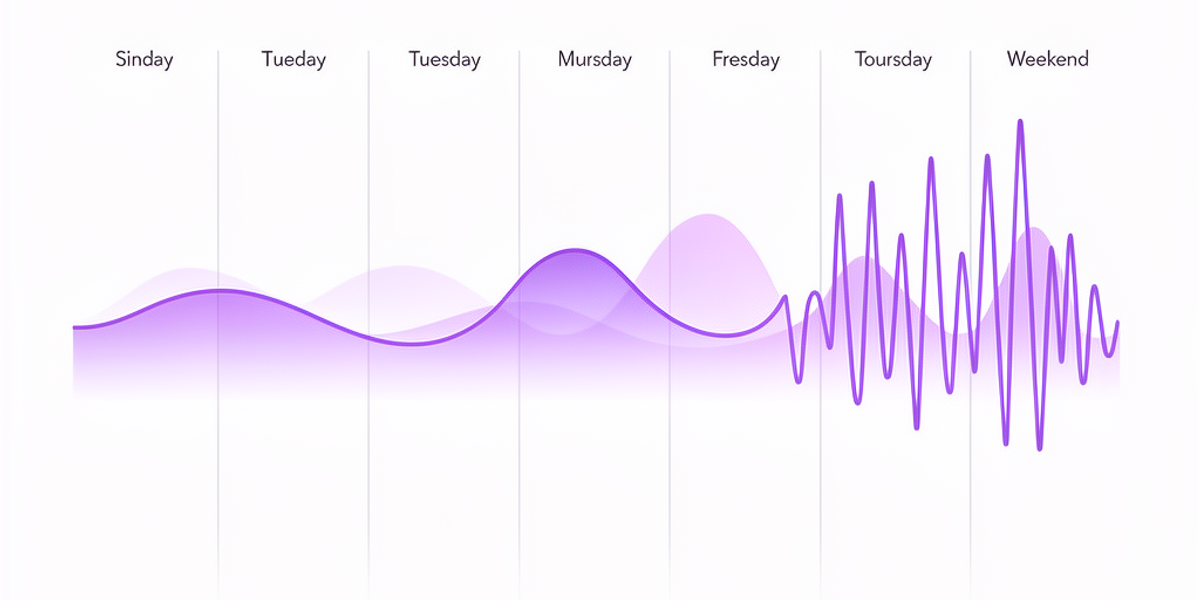
Ever wonder why you feel exhausted on Monday despite sleeping in all weekend? It's called social jet lag. Discover how gently shifting your weekend sleep patterns can support your circadian rhythm and bring more balanced energy to your week.
The Friday Night Illusion
It is a deeply familiar feeling. It’s Friday evening, the workweek has finally wrapped up, and the heavy mental load you have been carrying for the past five days can finally be set down. You turn off your early morning alarm with a profound sense of relief. Saturday morning arrives, and you sleep in—maybe for an extra hour, maybe for three. It feels glorious. You might do the exact same thing on Sunday.
But then Sunday evening rolls around. You lie in bed, wide awake, staring at the ceiling as the familiar Sunday night dread creeps in. When your alarm finally shatters the silence on Monday morning, you feel like you have been hit by a truck. Your eyes are heavy, your brain is foggy, and despite having spent more time in bed over the weekend than you did all week, you feel utterly exhausted.
We have all been there. It feels like a betrayal—you finally gave your body the rest it was desperately asking for, so why are you so tired?
The answer lies in a fascinating biological phenomenon known as "social jet lag." And understanding how it works might just be the key to reclaiming your energy, without ever feeling like you have to sacrifice your much-needed weekend rest.
What Exactly is Social Jet Lag?
Social jet lag occurs when there is a mismatch between your body's biological time (your internal circadian rhythm) and your social time (the schedule dictated by your work, family, and weekend habits).
When you wake up at 6:30 AM Monday through Friday, but sleep in until 9:30 AM on Saturday and Sunday, you are effectively shifting your time zone by three hours. From your brain's perspective, you just flew from New York to California for the weekend. Your body begins the complex work of adjusting to this new Pacific Time schedule. But just as it starts to settle in, Sunday night arrives, and you demand that it fly immediately back to Eastern Time for Monday morning.
Research suggests that this weekly back-and-forth takes a significant toll on our bodies. Just like actual travel-induced jet lag, social jet lag can leave us feeling chronically fatigued, moody, and out of sorts. It can disrupt our digestion, impact our focus, and make the start of the week feel incredibly difficult to navigate.
The Science of Your Internal Clock
To understand why this happens, it helps to look at how our bodies are designed to experience time. Deep within your brain is a tiny cluster of cells called the suprachiasmatic nucleus (SCN). This is your master clock. It relies on consistency—specifically, the consistency of light and dark, and of waking and sleeping—to regulate almost every system in your body.
When you wake up at the same time every day, your SCN knows exactly when to release cortisol (the hormone that makes you feel alert and awake) and when to release melatonin (the hormone that makes you feel sleepy).
When you sleep in on the weekend, you delay that morning cortisol spike and miss out on early morning light. Consequently, your evening melatonin release is also delayed. This is exactly why you find yourself wide awake at 11:00 PM on Sunday night. Your clock has been pushed back, and your biology simply isn't ready for sleep, even though your Monday morning schedule demands it.
Why the "Catch-Up Sleep" Myth Lets Us Down
For a long time, we were taught to view sleep like a bank account. The logic seemed sound: if you are short on sleep by five hours during the workweek, you can simply deposit five extra hours of sleep on the weekend to balance the ledger.
However, biology is far more complex than a balance sheet. While the urge to catch up on sleep is incredibly valid—especially when you are feeling bone-tired—research suggests that binge-sleeping on the weekends does not fully reverse the cognitive or metabolic effects of weekday sleep deprivation. In fact, by drastically altering your sleep schedule, you might actually be confusing your body further.
If you are exhausted by Friday, of course you want to sleep in. There is absolutely no shame in that. Women, in particular, often carry invisible caregiving and household burdens that make weekday rest elusive. But finding a way to rest that doesn't inadvertently punish you on Monday morning is a beautiful way to show yourself care.
How Hormones and Life Stages Play a Role
It is important to acknowledge that every woman's body and life is different. Our sleep architecture is not static; it ebbs and flows with our life stages and our hormonal rhythms.
Many women find that their sleep is already delicate due to the natural fluctuations of the menstrual cycle. In the days leading up to your period, a drop in progesterone can raise your core body temperature and reduce the amount of REM sleep you get, leaving you feeling naturally more fatigued. During perimenopause and menopause, fluctuating estrogen levels can introduce night sweats and insomnia into the mix.
When you add social jet lag on top of a hormonal landscape that is already challenging your sleep, the exhaustion can feel overwhelming. This is why consistency becomes so deeply supportive. When our hormones are fluctuating, giving our bodies a predictable, steady rhythm of waking and sleeping provides a vital anchor. It signals to your nervous system that you are safe, stable, and secure.
The Mental Load and the Urge to Crash
We also have to talk about the mental load. If you are spending your weekdays managing a household, excelling at your career, raising children, or caring for aging parents, your nervous system might be spending a lot of time in a heightened state of alertness.
The urge to crash on Saturday morning isn't just about physical tiredness; it is often a desperate need for psychological rest. It is the desire to simply not have to "be" anywhere or "do" anything. Recognizing the difference between needing physical sleep and needing psychological rest is a profound step in understanding your own wellness.
Finding Your Unique Sleep Rhythms
There is a lot of rigid advice out there about sleep. You have probably seen the articles insisting that successful people wake up at 5:00 AM every single day, no matter what. Let’s leave that toxic positivity and one-size-fits-all advice at the door.
If you are a shift worker, a mother of an infant, or navigating a chronic illness, your sleep schedule is going to look different, and that is more than okay. The goal is not perfection. The goal is to find a gentle, supportive balance that honors your need for rest while protecting your energy for the week ahead.
Gentle Adjustments You Might Try
If you want to smooth out the transition between the weekend and the workweek, here are a few gentle, evidence-aware shifts you might try. Remember, you don't have to do all of these. Pick the one that feels the most nourishing to you.
1. The 60-Minute Window
Instead of forcing yourself to wake up at your exact weekday time on the weekend, try aiming for a 60-minute window. If your alarm typically goes off at 6:30 AM for work, you might try setting a gentle weekend alarm for 7:30 AM.
This gives you the psychological treat of sleeping in and an extra hour of physical rest, but it isn't a drastic enough shift to completely derail your circadian rhythm. Many women find that this simple boundary is the sweet spot between enjoying the weekend and protecting Monday morning.
2. The Strategic Power Nap
If you had a late night on Friday, or if you wake up on Saturday morning feeling like you simply haven't had enough rest, consider getting up within your 60-minute window and utilizing a strategic power nap later in the day.
A 20- to 30-minute nap in the early afternoon (between 1:00 PM and 3:00 PM) can work wonders. It helps clear out adenosine—the chemical in your brain that makes you feel sleepy—without dropping you into the deep stages of sleep that cause grogginess. Best of all, a short nap pays off some of your sleep debt without shifting your master clock the way sleeping in until noon would.
3. Harnessing Morning Light
Light is the most powerful tool we have for communicating with our circadian rhythm. When natural sunlight hits the receptors in our eyes, it sends a direct, undeniable signal to the brain that it is time to be awake.
If you do find yourself sleeping in a bit on the weekend, make intentional light exposure your very first priority when you wake up. Open the curtains immediately. Better yet, step outside onto the porch or balcony for five to ten minutes while you drink your morning tea or coffee. This bright light helps anchor your internal clock and can mitigate some of the effects of waking up later.
4. Reimagining the Weekend Wind-Down
Sometimes, the weekend sleep trap starts on Friday night. The excitement of the weekend can easily lead to staying up three hours past your usual bedtime, scrolling on your phone or binge-watching a show simply because you "don't have to wake up early."
While treating yourself to a late night occasionally is part of a joyful life, making it a regular habit fuels social jet lag. You might try creating a special, luxurious weekend wind-down routine. Maybe Friday night becomes about taking a long bath, reading a novel, or doing some gentle stretching, allowing you to go to bed relatively close to your normal time while still feeling like you are indulging in weekend relaxation.
Listening to Your Body Without Judgment
As you explore these ideas, the most important tool you can bring with you is self-compassion. If you have a weekend where you are completely exhausted and you sleep until 11:00 AM, please do not beat yourself up.
Your body is wise. Sometimes, the need for acute recovery overrides the need for circadian consistency. The goal is to notice how you feel. If sleeping in leaves you feeling rejuvenated and ready for the week, trust your body. But if you notice that your weekend sleep habits are consistently leaving you feeling foggy, anxious, and exhausted on Monday, view it as an invitation to gently adjust your habits.
Wellness is not about following strict rules; it is about tuning in to what your unique biology is asking for. It is about treating yourself with the same care and consideration you so freely give to others.
A Gentle Invitation for Your Next Weekend
As this coming weekend approaches, take a moment to pause and check in with yourself. What kind of rest do you actually need? Do you need extra hours of sleep, or do you need a break from your daily responsibilities?
You might try setting a gentle alarm just an hour past your usual wake time, opening your blinds to let the morning sun wash in, and seeing how your body responds. By creating a rhythm that honors both your need for deep rest and your body's love for consistency, you can step off the rollercoaster of social jet lag. You deserve to wake up on Monday morning feeling grounded, energized, and ready to embrace the week ahead.