What Your Sleep Quality Says About Your Overall Balance

Sleep is more than just rest—it's a mirror reflecting your overall wellness. Discover how sleep connects to energy, stress, nutrition, and movement, and learn gentle ways to restore balance to your unique daily life.
The Gentle Mirror of Sleep
We have all experienced those mornings where the alarm clock feels less like a gentle nudge and more like an unwelcome interruption. You wake up feeling like you have already lived a full day, despite having spent the last eight hours in bed. In our fast-paced world, it is incredibly common to view sleep as a simple transaction: we lie down, we close our eyes, and we expect to wake up refreshed. When that doesn't happen, it is easy to feel frustrated with our bodies.
But what if we shifted our perspective? What if, instead of viewing poor sleep as a failure or a standalone problem, we started seeing it as a gentle messenger?
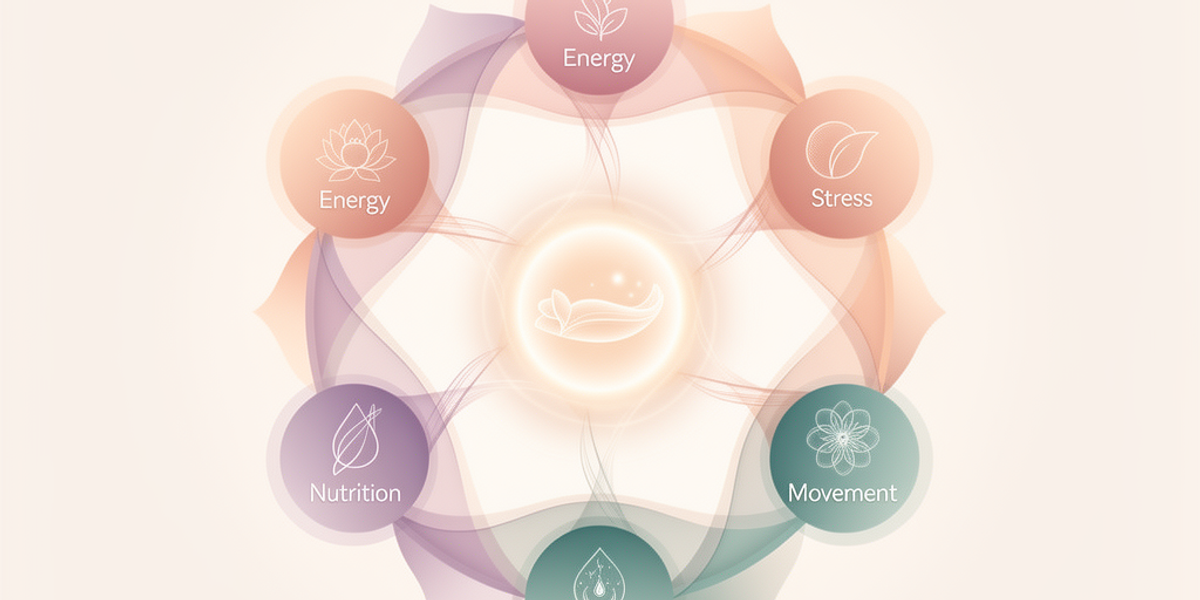
In the Richmond Balance framework, wellness is not a rigid checklist. It is a deeply interconnected ecosystem made up of core pillars: sleep, energy, stress, nutrition, and movement. Among these, sleep is perhaps the most honest barometer of our overall well-being. Your sleep quality is rarely just about what happens during the night; it is a vivid reflection of how you are moving, eating, feeling, and living during the day.
Every woman's body and life is intimately different. There is no one-size-fits-all approach to wellness, and acknowledging this is the first step toward true balance. By exploring how sleep weaves into the other pillars of your life, you can begin to listen to what your body is asking for—without judgment, without pressure, and with a deep sense of self-compassion.
The Sleep-Stress Connection: Unwinding the "Tired But Wired" Feeling
If you have ever lain awake staring at the ceiling, your body exhausted but your mind racing through tomorrow's to-do list, you have intimately experienced the sleep-stress connection.
Stress and sleep are locked in a delicate dance. Research suggests that when we experience high levels of chronic stress, our nervous systems remain in a sympathetic "fight or flight" state. This elevates cortisol, a hormone naturally designed to wake us up in the morning and keep us alert. When cortisol levels remain elevated into the evening, transitioning into the restorative parasympathetic "rest and digest" state becomes incredibly difficult.
Breaking the Cycle with Compassion
When poor sleep happens, it is natural to stress about the fact that you aren't sleeping, which ironically creates more stress. This is where releasing toxic positivity becomes essential. It is entirely okay to admit, "I am really stressed right now, and my sleep is suffering because of it." You do not have to force yourself to feel perfectly calm.
Instead of demanding sleep from your body, many women find it helpful to focus simply on resting. Removing the pressure to fall asleep can sometimes be the exact permission your nervous system needs to finally let go. You might try incorporating small, grounding moments throughout your day—a few deep breaths between meetings, a five-minute walk outside, or simply pausing to feel your feet on the floor. These micro-moments of regulation tell your nervous system that you are safe, paving the way for softer, more peaceful evenings.
Sleep and Nutrition: A Two-Way Street of Nourishment
When we talk about nutrition, it is vital to leave diet culture at the door. Your body is not a calculator, and food is not something to be earned. Food is nourishment, pleasure, and energy. Interestingly, the way we nourish ourselves profoundly impacts our sleep, and in turn, our sleep dramatically shapes how we nourish ourselves.
Have you ever noticed that after a night of tossing and turning, you find yourself craving carbohydrate-rich or sugary foods? This is not a lack of willpower; it is basic biology. Research suggests that sleep deprivation disrupts our hunger hormones. It increases ghrelin (the hormone that signals hunger) and decreases leptin (the hormone that signals fullness). Your body is incredibly intelligent—when it lacks the restorative energy of sleep, it asks for the quickest form of energy available: food.
Nourishing Your Rest
Conversely, what we consume during the day affects how we rest at night. Relying heavily on caffeine to push through the afternoon slump can linger in your system, disrupting your natural sleep architecture.
There is no "perfect" way to eat for sleep, as every woman's nutritional needs fluctuate based on her cycle, her life stage, and her unique physiology. However, you might try noticing how different foods make your body feel as the evening approaches. Many women find that enjoying a balanced, satisfying dinner that includes complex carbohydrates, gentle proteins, and healthy fats helps stabilize blood sugar through the night, preventing those sudden 3:00 AM wake-ups.
Listen to your body's cravings with curiosity rather than criticism. If you are exhausted and craving comfort, offer yourself that comfort while gently exploring how you can support your body's deeper need for rest.
Movement and Rest: Finding Your Unique Rhythm
Movement is a beautiful way to celebrate what our bodies can do, but its relationship with sleep is deeply nuanced. While regular movement is one of the most effective ways to improve sleep quality, the type, timing, and intensity of that movement matter immensely.
We often internalize the message that we need to push ourselves to the limit to "earn" our rest. But overtraining or engaging in high-intensity workouts when we are already depleted can backfire. Intense exercise is a stressor on the body. While it is a positive stressor (eustress), it still raises cortisol and adrenaline. If you are already carrying a heavy mental or emotional load, adding intense physical stress can leave your nervous system too revved up to settle down at night.
Honoring Your Energy Levels
Your movement practice should support your life, not drain it. If you are going through a season of fragmented sleep—perhaps due to perimenopause, raising young children, or navigating a demanding career phase—it might be time to adjust your movement expectations.
Many women find that shifting vigorous movement to the morning or early afternoon allows their core body temperature and stress hormones to drop naturally by bedtime. If the evening is your only time to move, you might try gentle, restorative practices like stretching, slow yoga, or a leisurely walk.
Pay attention to how you feel after you move. Do you feel energized and grounded, or depleted and wired? Let your body's response be your guide. Trust that a gentle walk is just as valid and valuable as a strenuous workout, especially when it protects your precious rest.
Energy: The Beautiful Output of Balance
In the Richmond Balance framework, energy is the ultimate culmination of how we manage our sleep, stress, nutrition, and movement. But energy is not just physical stamina. It is your mental clarity, your emotional bandwidth, and your capacity to engage joyfully with the people and passions you love.
When sleep is compromised, our energy bucket leaks. We might find ourselves snapping at our loved ones, struggling to focus on simple tasks, or feeling an overwhelming sense of apathy. It is vital to recognize that this is a systemic response, not a personal failing. You are not lazy; you are functioning with a depleted battery.
When we begin to view sleep as the foundational layer of our energy, we start treating it with the reverence it deserves. We stop wearing exhaustion as a badge of honor and start fiercely protecting our boundaries. Saying "no" to an evening commitment so you can wind down early is not selfish; it is an act of profound self-preservation that allows you to show up more fully for your life the next day.
Gentle, Actionable Ways to Support Your Sleep
If your sleep quality is signaling that your overall balance is off, the goal is not to overhaul your entire life overnight. That would only create more stress! Instead, consider embracing small, gentle shifts. Here are a few supportive practices you might try, taking only what resonates with you and leaving the rest:
1. Create a Sensory Wind-Down
Transitioning from the demands of the day to the surrender of sleep requires a bridge. You might try creating a wind-down routine that appeals to your senses. Dimming the overhead lights, lighting a favorite candle, listening to soft music, or applying a soothing lotion can signal to your brain that the workday is officially over.
2. Practice an Evening "Brain Dump"
If a racing mind is keeping you awake, keeping a notebook by your bed can be deeply supportive. Before you turn off the light, write down your lingering thoughts, worries, and tomorrow's to-do list. Physically moving these thoughts from your brain to the paper can provide a profound sense of relief.
3. Embrace Morning Light
Our circadian rhythms are heavily influenced by light. Many women find that stepping outside into natural sunlight within the first hour of waking helps anchor their internal clock. Even just five minutes of morning light on your face while you drink your coffee can gently cue your body to release melatonin earlier in the evening.
4. Release the Pressure
If you wake up in the middle of the night, try to avoid looking at the clock. Calculating how many hours you have left before the alarm goes off only fuels anxiety. Remind yourself that simply resting quietly in the dark is still restorative for your body.
A Journey, Not a Destination
Finding balance is not about achieving perfect harmony every single day. There will be nights when sleep evades you, days when stress feels heavy, and seasons where movement looks completely different than you planned. That is the beautiful, messy reality of being a human being.
Your sleep quality is simply a compass, gently pointing you toward the areas of your life that might need a little extra tender loving care. By listening to what your sleep is telling you about your stress, nutrition, movement, and energy, you can begin to make choices that honor your unique needs.
Take a deep breath. You are doing a wonderful job. Tonight, as you prepare for bed, I encourage you to offer yourself a moment of grace. Thank your body for carrying you through the day, let go of any expectations for the night ahead, and simply allow yourself the gentle permission to rest.