How to Read a Nutrition Label Without Anxiety: The Only 3 Things That Actually Matter

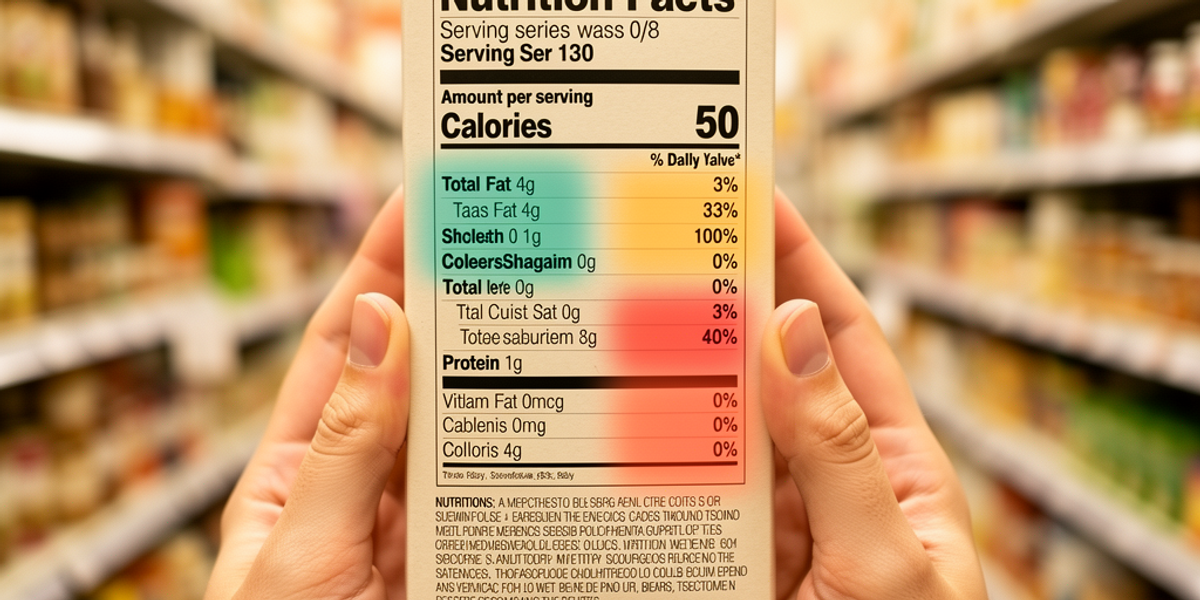
Grocery shopping shouldn't feel like a math test. Discover how to read nutrition labels without anxiety by focusing on just three gentle metrics: serving size, fiber, and added sugar. Everything else is simply noise.
Picture this: You are standing in the middle of the grocery store aisle. The fluorescent lights are humming above you, your cart is half-full, and you are holding a box of crackers in one hand and a bag of granola in the other. You flip them over to look at the nutrition labels, and suddenly, that familiar tightness in your chest begins to build.
There is a dizzying wall of numbers, percentages, grams, and unpronounceable ingredients staring back at you. Calories, fat, saturated fat, trans fat, cholesterol, sodium, total carbohydrates, vitamins—it feels less like picking out a snack and more like taking a high-stakes chemistry exam.
If this scenario sounds familiar, please know that you are not alone. For decades, diet culture has taught us to view the Nutrition Facts panel as a strict report card, a moral compass that dictates whether a food is "good" or "bad," "clean" or "guilty." We have been conditioned to scrutinize every single line, leading to a phenomenon of profound grocery store paralysis.
But what if we could gently let all of that go? What if reading a nutrition label didn't have to be a source of stress?
The truth is, the standard nutrition label was originally designed by regulators and scientists, not by people trying to live balanced, joyful lives. It contains a lot of data, but data is not the same thing as wisdom. For the everyday woman simply trying to nourish her body while balancing work, family, and her own well-being, 90% of that label is just noise.
To find peace in the grocery aisles, we can simplify our approach. You don't need to analyze a dozen different metrics. In fact, to make informed, supportive choices for your body, there are really only three things that actually matter: serving size, fiber, and added sugar.
Let's break down this calm, practical guide to reading a nutrition label without the anxiety.
The Problem with the Noise
Before we dive into our three pillars, it is helpful to understand why we are actively choosing to ignore the rest of the label.
When we obsess over every single number—especially calories and fat grams—we lose sight of the actual food. We start viewing our meals as math equations to be solved rather than nourishment to be enjoyed. This hyper-fixation often leads to ignoring our body's natural hunger and fullness cues.
Furthermore, focusing too heavily on calories can be deeply misleading. A hundred calories of almonds and a hundred calories of a sugary soda behave entirely differently in your body. One provides sustained energy, healthy fats, and satisfaction; the other causes a rapid blood sugar spike followed by an inevitable crash.
By giving ourselves permission to tune out the noise, we are reclaiming our time and our mental peace. We are acknowledging that every woman's body and life is different, and no black-and-white grid on the back of a cardboard box knows what you need better than you do.
Pillar 1: Serving Size (Context, Not Control)
The very first thing to look at when you flip a package over is the serving size. However, it is crucial that we completely reframe how we think about this number.
Diet culture has taught us to view the serving size as a limit, a rule, or a strict boundary. If the serving size says "15 crackers," we might feel intense guilt if we eat 20. But the serving size is not a prescription. It is simply a unit of measurement. It is the lens through which the rest of the numbers on the label make sense.
Think of the serving size as the legend on a map. It just tells you how to read the terrain. If a pint of ice cream lists a serving size as 2/3 of a cup, and you know you usually eat about double that amount when you dish it out, that is perfectly fine! The serving size is just letting you know that whatever numbers you see below it need to be doubled to reflect what is in your bowl.
Many women find that when they stop viewing the serving size as a dietary restriction and start viewing it as mere context, a massive weight is lifted. It allows you to make informed decisions without judgment. You are simply gathering data about the food you are bringing into your home. It helps you understand the concentration of the nutrients you are about to eat, allowing you to honor your hunger while staying gently aware of what you are consuming.
Pillar 2: Fiber (The Unsung Hero)
Once you have your context from the serving size, skip right past the calories, the fat, and the cholesterol. Let your eyes land gently on Dietary Fiber.
If there is one nutrient we should be celebrating, it is fiber. For a long time, protein has been the superstar of the wellness world, but fiber is the quiet, hardworking hero, especially for women's bodies.
Research suggests that a diet rich in fiber supports a healthy gut microbiome, which is intricately linked to our digestion, our immune system, our mood, and even our hormonal balance. Fiber is what gives plant foods their structure. When we eat it, it slows down the digestion process, which means our bodies absorb energy at a steady, manageable rate rather than all at once.
This steady absorption is the secret to avoiding the mid-afternoon energy crash. It keeps us feeling full, satisfied, and grounded.
When looking at the label, check to see if the food offers a meaningful amount of fiber. As a gentle benchmark, a food that has 3 to 5 grams of fiber per serving is a great source.
Notice how we are shifting the focus here. Instead of looking at a label to see what we should restrict or avoid (like calories or fat), we are looking at the label to see what we can add to our bodies to help them thrive. This is a mindset of abundance, not scarcity. If a food doesn't have much fiber, it doesn't mean it is a "bad" food—it just means you might want to pair it with something that does, like adding a handful of berries to your yogurt or some sliced avocado to your toast.
Pillar 3: Added Sugar (Information, Not Fear)
The final stop on our simplified nutrition label tour is Added Sugars.
Notice that we are looking specifically at added sugars, not total sugars. This distinction is vital for maintaining peace of mind. Total sugars include naturally occurring sugars, like the fructose found in fruit or the lactose found in dairy. Nature is incredibly smart; it packages these natural sugars alongside water, vitamins, and—you guessed it—fiber. An apple contains sugar, but it is wrapped in a beautiful, fibrous package that your body knows exactly how to handle.
Added sugars, on the other hand, are the sugars and syrups put into foods during processing. They are often hiding in places you wouldn't expect, like savory pasta sauces, salad dressings, breads, and flavored yogurts.
We look at added sugar not to fear it, but to stay informed. When our bodies consume high amounts of added sugar without the balancing effects of fiber or protein, it can lead to sharp spikes and drops in our blood sugar. This can leave us feeling jittery, fatigued, or craving more sugar to get our energy back up. Over time, navigating these constant spikes can be exhausting for our systems.
When checking the label, you might try aiming for foods that have lower amounts of added sugar for your everyday staples. A common gentle guideline is looking for items with single-digit grams of added sugar per serving for everyday snacks and meals.
But remember: this is not about achieving zero sugar or striving for purity. A life without a slice of birthday cake, a favorite chocolate bar, or a sweetened coffee on a crisp morning is not the goal. The goal is simply awareness. If you see that your favorite daily yogurt has 15 grams of added sugar, you don't have to throw it away. You might just decide to buy the plain version next time and add your own honey or fruit, giving you more agency over how your food is sweetened.
Putting It Into Practice
Let's take this calm, three-step method back to the grocery aisle.
You are holding two boxes of cereal. Instead of agonizing over the entire label, you take a deep breath and look at the three pillars.
First, you check the serving size. Both are about 1 cup. Great, you have your context.
Next, you look at the fiber. Box A has 1 gram of fiber. Box B has 5 grams of fiber. You know that Box B is going to give you more sustained energy and keep you feeling satisfied much longer throughout your morning.
Finally, you check the added sugar. Box A has 12 grams of added sugar. Box B has 4 grams of added sugar.
Without needing to look at the calories, the fat percentages, or the sodium levels, you have all the information you need to make an empowered choice. Box B offers more structural nourishment (fiber) and less of the stuff that might cause a mid-morning energy crash (added sugar). You place Box B in your cart, and you move on with your day. No anxiety, no math test, no guilt.
A Gentle Note on Ingredients
While we are keeping things simple with the numbers, you might occasionally glance at the ingredient list. The same rules of peace apply here. We do not need to fear every word we cannot pronounce—sometimes the scientific name for a simple vitamin sounds like a scary chemical.
However, a good rule of thumb is to look for ingredient lists that read somewhat like a recipe you could make in a kitchen. If the first few ingredients are whole foods (like whole wheat, oats, tomatoes, or almonds), you are generally on a supportive path.
Finding Your Unique Balance
As you begin to practice this simplified approach to reading labels, be incredibly gentle with yourself. Unlearning years of diet culture conditioning takes time. You might still catch your eyes darting to the calorie count out of habit. When that happens, just take a breath, acknowledge the habit, and gently guide your eyes down to the fiber and added sugar.
Remember that every woman's body is entirely unique. What feels satisfying and nourishing to your best friend might feel different to you. There is no one-size-fits-all approach to wellness, and there is no such thing as a perfect grocery cart.
Food is meant to be a source of pleasure, connection, and energy—not a source of anxiety. By focusing only on the serving size for context, fiber for nourishment, and added sugar for awareness, you are stripping away the noise. You are choosing to trust your body.
The next time you find yourself in the grocery store feeling that familiar wave of overwhelm, I invite you to try this gentle method. Pick up a package, find your three pillars, and give yourself the beautiful permission to ignore the rest. You deserve to shop, eat, and live with peace.